
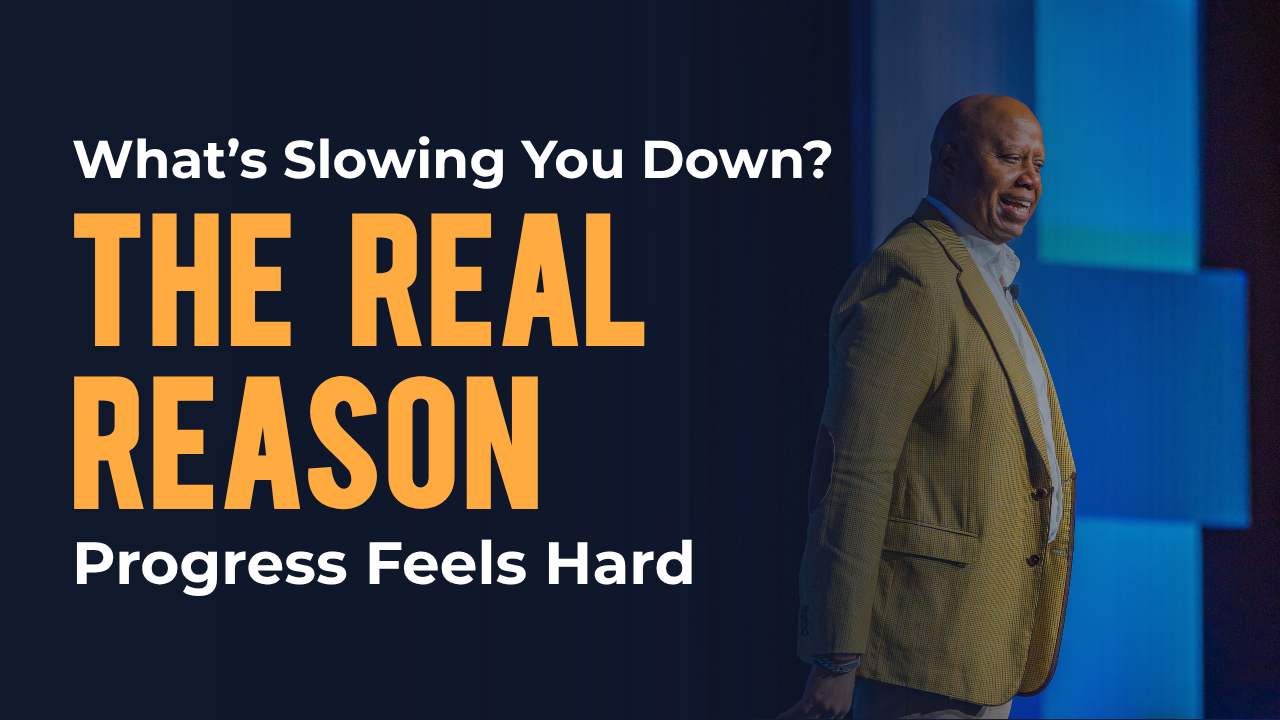
What’s Slowing You Down? The Real Reason Progress Feels Hard
Imagine Driving with the Parking Brake On
Imagine getting into your car, pressing the accelerator, and pushing harder than ever.
The engine responds.
The fuel burns.
The effort is there.
Yet somehow, you’re still moving slower than you should.
Why?
Because the parking brake is still engaged.
That’s how many people and organizations operate every day.
They don’t have an effort problem.
They have a friction problem.
They work harder.
Stay later.
Push more.
Yet progress still feels slower than it should.
And the reason is simple:
Something is holding them back.
Until you identify what’s slowing you down, acceleration remains impossible.
The Myth of More Effort
One of the biggest misconceptions in business and life is the belief that more effort automatically produces more results.
Sometimes it does.
Often it doesn’t.
Because effort cannot overcome a lack of direction.
Effort cannot fix confusion.
Effort cannot compensate for poor systems.
Effort cannot overcome misalignment.
Yet many leaders continue responding to challenges the same way:
Work harder.
Push harder.
Do more.
Add more meetings.
Add more initiatives.
Add more activity.
The result?
People become exhausted without becoming more effective.
Teams become busy without becoming more productive.
Organizations become overwhelmed without becoming more successful.
The answer isn’t always more effort.
Sometimes the answer is removing what’s creating resistance.
Four Things That Slow Progress
When Walter wrote Accelerate, the goal wasn’t to teach people how to work harder.
The goal was to help people identify what is preventing them from moving forward.
Over the years, I’ve found that most progress slows down because of four common obstacles.
1. Lack of Vision
You cannot accelerate toward an unclear destination.
It sounds obvious.
Yet many people and organizations spend years operating without a clearly defined vision.
They know they want growth.
They know they want better results.
But they cannot clearly articulate where they are going.
Vision creates direction.
Direction creates alignment.
Alignment creates momentum.
Without vision, people stay busy but rarely move forward intentionally.
The first question every leader must answer is:
Where are we going?
Because if the destination isn’t clear, acceleration becomes impossible.
2. Lack of Clarity
Vision tells you where you’re going.
Clarity tells you what to do next.
This is where many organizations get stuck.
Too many priorities.
Too many initiatives.
Too many distractions.
Too much complexity.
Progress begins when confusion ends.
The most successful leaders have an incredible ability to simplify.
They identify what matters most.
They eliminate what doesn’t.
They help their teams focus on the next right action.
Because clarity creates momentum.
And momentum creates progress.
3. Lack of a Playbook
Even with vision and clarity, execution eventually breaks down without a system.
That’s where the playbook comes in.
A playbook defines:
- Standards
- Expectations
- Processes
- Winning behaviors
Without a playbook, every challenge requires reinvention.
Every decision becomes harder.
Every result becomes inconsistent.
Winning organizations don’t leave execution to chance.
They build systems that make success repeatable.
Because consistency always beats intensity over the long run.
4. The Wrong People
This may be the most overlooked obstacle of all.
People either accelerate progress or create drag.
There is no neutral.
The right people:
- Strengthen the culture
- Reinforce the vision
- Raise standards
- Execute the playbook
The wrong people create friction.
They drain energy.
They create confusion.
They slow momentum.
Every organization eventually becomes a reflection of the people it tolerates, develops, and rewards.
That’s why people maximization is not optional.
It’s essential.
How Winning Organizations Accelerate
The organizations growing today aren’t necessarily the largest.
They aren’t always the most funded.
They aren’t always the most talented.
They’re often the most aligned.
They understand that acceleration isn’t about adding more.
It’s about removing what’s slowing progress.
They get clear on the vision.
They simplify priorities.
They create a playbook.
They develop the right people.
And as friction disappears, momentum takes over.
A Better Question
Most people spend their lives asking:
“How can I do more?”
A better question is:
“What is slowing me down?”
Because acceleration doesn’t happen when you add more weight.
It happens when you remove what is holding you back.
That’s true in leadership.
It’s true in business.
It’s true in life.
Final Thought: Progress Before Acceleration
Before a rocket can accelerate, it must first break free from gravity.
The same is true for people and organizations.
Before you can accelerate growth, performance, and results, you must identify the forces working against you.
That’s why the Make Progress movement starts with focus, vision, clarity, playbook, and people.
Because once those foundations are in place, something powerful happens.
Progress stops feeling difficult.
Momentum begins to build.
And what once felt impossible starts to accelerate.
The question isn’t whether you’re capable of more.
The question is:
What’s slowing you down?
And what are you going to do about it?
Ready to Accelerate?
If your organization is ready to eliminate friction, improve execution, and create sustainable momentum, Walter Bond helps leaders and teams build the foundations that drive real results.
👉 Book Walter Bond for your next event.
👉 Explore leadership and performance programs.
👉 Discover the principles behind Accelerate: The Champion’s Playbook for Growth.
Make Progress. Then Accelerate.