
How Do You Make Progress When Staying the Same Feels Easier?
About 10 years ago, after Antoinette and I had spent approximately 15 years building our speaking business, I came to her and said, “I want more.”
I wasn’t talking about more applause, more recognition, or even more stages. I wanted to have more impact.
At the time, our business was built primarily around one product: my keynote. I would enter a room, deliver a powerful message, inspire people to move, and then leave for the next event.
But I started noticing something.
People wanted more.
They did not just want to feel inspired for an hour. They wanted help applying what they had heard. They needed tools, coaching, accountability, and continued support. They wanted someone to help them keep moving after the event ended.
I knew we had more to give, but our business was not structured to give it.
Something had to change.
Progress Required Us to Get Uncomfortable
Antoinette understood what I was saying. She could see the opportunity too. But she also understood something I had not fully considered: the amount of growth this new season would require from both of us.
We had spent years learning how to operate a successful speaking business. We understood our roles. I delivered the keynote, and Antoinette managed and grew the business behind it.
The model worked.
We were not changing because everything was falling apart. We were changing because the impact we wanted to have had become bigger than the business we had built.
And honestly, Antoinette was content.
She was proud of what we had created. She understood what it took to operate it. Expanding beyond the keynote would require new products, new systems, new skills, new responsibilities, and new versions of both of us.
That is when we encountered one of the most important truths we have learned about progress:
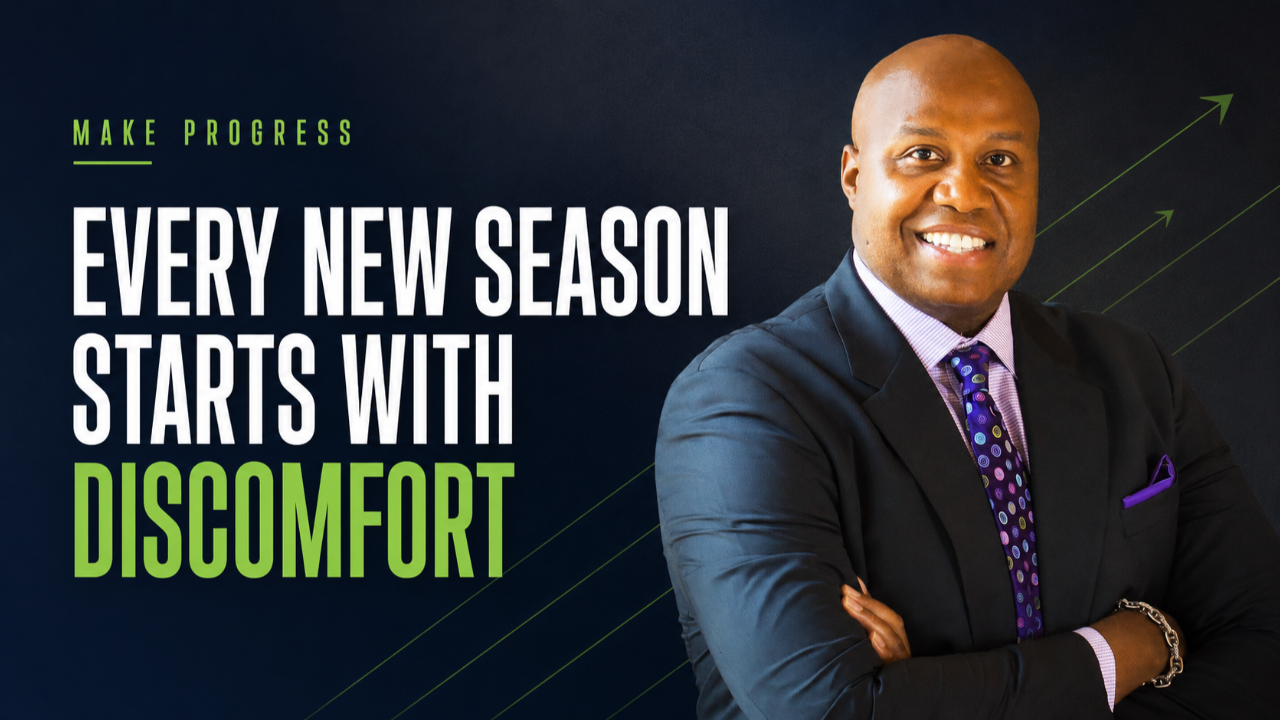
Every new season starts with discomfort.
Staying the same is usually easier. It is familiar. You know the expectations, the routines, and the roles.
But if you remain comfortable for too long, you can miss your next opportunity to grow, contribute, and serve.
You can be grateful for where you are and still recognize that you cannot remain there.
Progress Does Not Always Begin With Failure
We often assume that people change because something has gone wrong.
But sometimes progress does not begin with failure. It begins when you realize that your current level of success has reached the limit of what it can produce.
We were not trying to escape a failing business. We were being called to expand a successful one.
That required us to stop asking, “How do we protect what we have?” and begin asking, “What must we become to serve people at the next level?”
That question eventually changed everything.
It pushed us beyond a business built around a speaker and a keynote. We began developing books, coaching, training, assessments, playbooks, advisory services, and the Peak Performers Huddle.
We did not create it all overnight. We made progress one decision, one lesson, and one rep at a time.
Looking back, I can see that our journey followed what we now call the 8 Keys to Progress.
The 8 Keys to Progress
P — Purpose: Decide what you are pursuing
Our purpose became clearer: we did not want to inspire people for only one hour. We wanted to equip them to keep making progress after the event ended.
Purpose gives progress a destination.
Ask yourself:
What greater impact am I being called to make?
R — Rally: Bring the right people together
I may have been the one standing on the stage, but this vision was never going to become a reality through me alone.
Antoinette and I had to align around the new vision. We needed one another, and we needed a larger huddle of people with the skills, experience, and commitment to help us build it.
Progress is personal, but it is rarely accomplished alone.
Ask yourself:
Who needs to be in my huddle for this next season?
O — Ownership: Accept responsibility for the change
It would have been easy to complain that the speaking industry was changing or that audiences wanted more than they had in the past.
But ownership required us to ask a better question:
What do we need to change?
Ownership means refusing to wait for the market, the opportunity, or another person to move first. You recognize what is in your control, and you take the next step.
G — Grit: Remain committed through discomfort
Building something new while operating what already exists is difficult.
There were ideas that did not work, products that needed to be redesigned, new responsibilities to carry, and hard conversations to have. We had to keep moving even when the path was unclear.
Grit does not mean you always know what to do. It means you remain committed to discovering the next right move.
R — Reps: Repeat the work that creates growth
We did not become coaches, advisors, trainers, authors, and community builders by declaring it.
We had to do the reps.
We coached people. We listened to what they needed. We built programs. We tested ideas. We studied our results. We improved our language. We refined the message and continued showing up.
Progress is not one giant leap. It is the accumulation of the right actions repeated consistently.
E — Elevate: Help other people rise
The desire to elevate others was the reason we changed in the first place.
We wanted people to leave my keynote with more than a good feeling. We wanted them to have a target, a playbook, and the right people around them to help them keep moving.
Your progress becomes more powerful when it helps someone else make progress too.
S — Standards: Raise the quality of what you deliver
If we wanted to provide more than a keynote, we had to develop more than inspiration.
We had to create practical frameworks, strong teaching, meaningful experiences, and systems people could use long after I left the stage.
Wanting more impact required us to raise our standards for what real impact looked like.
S — Service: Make your progress matter
Service is the reason progress matters.
Staying the same may have been more comfortable, but it would have limited the number of people we could serve and the depth of the transformation we could help create.
We did not need to abandon the keynote. We needed to build beyond it.
Today, when I speak, I know the audience does not have to be left with inspiration alone. There is a larger ecosystem of tools, coaching, community, and support available to help individuals, leaders, and organizations continue the work.
That was the impact we were trying to create.
And we are still making progress.
What Is Your Discomfort Trying to Tell You?
You may be entering a new season right now.
Perhaps your current role has become too small for the contribution you are capable of making. Maybe your business model has reached its limit. Maybe the people you serve need something different from you. Or perhaps you already know what needs to change, but you have been avoiding the discomfort that comes with changing it.
Do not assume that discomfort means you are on the wrong path.
Sometimes discomfort is evidence that you have reached the edge of your current capacity—and your next level is asking you to grow.
Staying the same may be easier, but ease is not always the goal.
The goal is progress.
Start with the questions we had to ask ourselves:
- What impact do I want to have?
- What must change for that impact to become possible?
- Who must I become in the process?
- Who needs to be in my huddle?
- What is the next rep I need to take?
You do not have to know every step.
You need a clear target, a practical playbook, the right people around you, and the courage to become uncomfortable.
Find your lowest key. Take your next rep. Make Progress.